You Have a Business Plan, Now What?

You’ve spent countless hours drafting, researching, and refining your business plan. Congratulations, you’re one step closer to your entrepreneurial dream! Now, how do you start a business, what do you do with your business plan? Having a business plan is just the beginning. Now, it’s time to put it into action.  

A business plan is like a blueprint; it’s only effective if it is followed, executed, and adjusted as you move forward. So, after creating your business plan, what is the next step? 

Here are the steps next to turn your business plan from paper into profit. 

  1. Test The Business 
  2. Conduct Surveys & Focus Groups 
  3. Secure Funding 
  4. Develop & Execute Your Marketing Plan 
  5. Track Progress and Adjust 

Test the Business

Even the best-crafted business plans can hit bumps when they are put into action. A great idea can sometimes have challenges translating in the market. So once your business plan is complete, it is important to test your plan in the real world with real customers. This step allows you to fine-tune your approach early before committing more time and resources. 
 

Offering limited runs or trials to early adopters helps you refine your product and business approach and is an important step when you start your business. It is important to evaluate the pilot tests and understand what worked, what didn’t work, and what can be changed to work better. Early testers and adopters are also crucial for creating buzz and word-of-mouth marketing, so it is important to leave a good first impression during this period. 

Conduct Surveys and Focus Groups

Getting feedback on your idea directly from your target audience is vital. Surveys, interviews, or focus groups can reveal opportunities or pain points you might have missed in your initial feedback. Determining what you want to get feedback on is a great first step in creating a survey or focus group. You can ask a series of targeted questions to get the answers you need to create actionable insights on specific areas. Gathering and incorporating your feedback can also help you realize what you are doing well, what needs adjusting, and what the market needs. Collecting feedback will give you confidence as you move forward knowing that your small business resonates with people.

Secure Funding

If your business requires capital, securing the right funding is essential. There are a number of ways to gain additional funds, and knowing which one is right for you can sometimes feel a little overwhelming. At Mainstreet, our Commercial and Agricultural Account Manager‘s are available to help you with a range of lending options tailored to your specific needs. They will be able to work with you to review your financial situation and recommend the best funding solutions  to meet your goals. Book an appointment today to learn more about the options available to you. . 

In addition, there are also a range of grants or community resources that may be available to you. We encourage you to connect with your local Small Business Enterprise Centre and Community Futures location, or visit the province of Ontario website. Grants can be a great resource that you could utilize to kickstart your business!  

Remember, maintaining ongoing financial health is key to sustaining your business long-term and beyond the initial funding.

Develop Your Brand and Execute Your Marketing Plan

A brand is more than just a logo, it is the story behind your business and how you connect with customers. Having a plan on how to share that story and separate yourself from the competition is crucial. To create an effective marketing plan, it is important to understand where your customers are and the best way to reach them. Developing a website and digital footprint is usually a great low cost first step to help make your business easily found and have conversations with customers. Mapping out a plan that is based on research and aligned to your brand can go a long way in establishing your business, especially if you are just starting out.

Track Progress and Adjust

Being a successful business owner means staying flexible and adapting quickly when necessary. Even with a solid business plan, it’s essential to monitor your progress and be ready to pivot when needed. Market conditions and customer preferences can shift, and if your business isn’t performing as expected, it doesn’t mean your idea isn’t viable—it might just need some fine-tuning or better timing. Whether you’re seeking financing or just want a strategic check-in, our team is here to support you. 

Starting and growing a business demands ongoing learning, flexibility, and persistence. Each step you take after creating your business plan moves you closer to achieving your small business goals. Don’t hesitate to seek advice, reassess your strategy, and celebrate each milestone along the way. 

At Mainstreet, we’re committed to being your partner on this journey. Book an appointment today with one of our Commercial and Agricultural Account Managers to explore how we can help you meet your goals and grow your business with confidence. We’re here to provide the support and solutions you need—let’s take the next step together.


8 Essential Resources to Help Ontario Business Owners Thrive

Did you know that over 98% of businesses in Ontario are small businesses? Yet many entrepreneurs struggle to access the right resources when starting out. Starting a small business in Ontario can be daunting and jumping into the unknown with limited business experience can leave you having more questions than answers. Fortunately, Mainstreet Credit Union has Commercial and Agricultural Account Managers who specialize in small business lending, financial advice, and banking solutions. To help get you started, we’ve compiled a list of 8 resources at the local, provincial, and federal levels. These resources cover everything from drafting your business plan to navigating legal requirements to securing grants.

Essential Government Resources for Ontario Businesses

When you have a promising business idea, you might quickly find yourself wondering exactly how to start a business in Ontario. Fortunately, the business, workplace, and economy page on the Government of Ontario website is an excellent starting point, offering a wealth of free resources designed to help you navigate the process. One of the first steps to becoming a successful small business owner is preparing a comprehensive business plan, which acts as the blueprint for your business. On this site, you will find resources like a downloadable business plan template to get started.

Beyond business planning, the government website also provides guidance on essential tasks such as registering your business, understanding the tax requirements, and familiarizing yourself with relevant rules and regulations. Additionally, Ontario offers several small business grants, which may provide extra funding opportunities for new businesses, depending on the nature of your venture. These resources can make a significant difference in turning your business idea into a reality.

Business Guide For Newcomers To Canada

For newcomers to Canada who are interested in starting their own business, there is often a lot to learn about how businesses are established and operated in the country. To help with this process, the Government of Canada has created the Business Guide for Newcomers, a valuable resource that outlines the essential steps for starting a business in Ontario. This guide covers everything from a business plan template to understanding the necessary licenses and permits, as well as providing a detailed start-up guide to help you embark on your journey as a small business owner and newcomer to Canada.

It’s also crucial to grasp the legal aspects of running a business, including what activities are allowed, what restrictions may apply, and which types of work permits or business licenses you might need. Being well-informed about these requirements will help you avoid potential legal issues and set your business up for long-term success.

Your Local Economic Department

Your local economic department offers a wide range of support to help businesses start, grow, and thrive. These community services offer valuable resources such as small business grants for additional funding, networking events to connect with entrepreneurs, and other programs aimed at helping you make a positive impact in your community.

It’s important to remember that each community has its own set of different municipal bylaws and zoning regulations, which you must follow to stay compliant. Researching these rules and staying up-to-date on any changes is key to avoiding any potential legal trouble.

At Mainstreet, we leverage our strong business connections and local expertise in our communities to direct you to the right resources for additional support. In the meantime, here is a list of local economic partners in our communities that can help grow your business and achieve success.

Small Business Enterprise Centres

The Small Business Enterprise Centres (SBECs) total 47 locations across Ontario. The SBECs offer entrepreneurs and small business owners all the tools they need to start and grow their businesses. Each SBEC has a team of dedicated professionals, who can offer unbiased advice on your business matters. They offer many services that any small business can take advantage of. From services like reviewing business plans, mentoring and networking, training, and small business grant opportunities. Your local SBEC has local and professional experience they can rely on and could be a key mentor in your journey as a small business owner.

Ontario Chamber of Commerce

When you start a business in Ontario the Ontario Chamber of Commerce and your local chamber of commerce offer a variety of programs designed to support the growth and development of local and Ontario small businesses. These programs connect business owners to digital adoption programs, trade and export events, and networking opportunities. They also help entrepreneurs identify their digital needs and help implement strategies to get their businesses online.

Mainstreet is actively involved in local chamber events, allowing us to stay connected with the local business community, gain insights into their needs, and continually enhance our understanding of the challenges and opportunities facing small businesses.

Pro-Bono Ontario

As a small business owner, there are a lot of legal considerations you’ll need to navigate. Pro-Bono Ontario is a great service that provides free legal help to small business owners over the phone. The Pro-Bono Ontario Hotline addresses common issues such as writing or reviewing business documents and contracts, understanding if you need to incorporate, or what should you look out for when signing a commercial lease.

To further support small business owners, there are a series of short videos on various topics to help small businesses, including basic employment law, an introduction to intellectual property, and a guide to getting paid.

Invest Ontario

Invest Ontario acts as a bridge between private and public sectors, streamlining the investment journey and offering comprehensive support every step of the way. Specializing in manufacturing, life sciences, and technology; they are committed to strategic investments that create jobs and drive Ontario’s long-term economic growth. They offer business guidance in optimizing government resources and securing strategic investments to drive long-term economic growth. Speak to Invest Ontario to learn sustainable ways to grow your business in Ontario.

Mainstreet Credit Union

Whether you’re just starting your business in Ontario or simply looking for additional small business resources, Mainstreet Credit Union is here to support you with free advice for both personal and commercial banking. From day-to-day banking needs to loans, lines of credit, or mortgages, we’re committed to helping you and your business thrive. We understand that every business is unique, so we take the time to understand your business, your specific needs, goals, and challenges to provide tailored solutions and advice.

In addition to our financial expertise, Mainstreet works with trusted local professionals across a range of industries to ensure you have access to all the resources necessary for your business to succeed. Book an appointment today and take the first step toward reaching your business goals with a trusted financial partner who’s dedicated to your business’s growth.

What is EBITDA and Why Should You Care?

What is EBITDA? 

If you’re an entrepreneur or business owner, you may have heard the term ‘EBITDA’ before, but do you know the meaning of EBITDA? Either pronounced ‘eh-bit-dah’ or ‘ee-bit-dah’, the word is an acronym for the phrase, ‘Earnings Before Interest, Taxes, Depreciation and Amortization’. EBITDA is a financial metric that shows a company’s profitability by focusing on its core operations, excluding costs related to financing, taxes, and non-cash expenses like depreciation and amortization. Essentially, EBITDA gives a clearer picture of a company’s operating performance, without the impact of financial and accounting decisions that often fluctuate. 

EBITDA is sometimes used to determine whether a business can support a potential loan, line of credit, or mortgage they may be looking to take on. It allows lenders and potential investors to understand profitability clearly and removes many variables that can make it hard to compare “apples to apples”. It’s important that business owners understand the EBITDA formula and how it is calculated because it could be the difference between securing a business loan or missing out on key growth opportunities. 

How do we calculate EBITDA? 

As we now know, EBIDTA is “earnings before interest, taxes, depreciation, and amortization.” To calculate EBITDA, we have to add those items back to earnings (also known as net income). 

The EBIDTA formula is EBITDA = Net Income (Earnings) + Interest + Taxes + Depreciation + Amortization 

Or if you have operating income, it can also be calculated as:  

EBITDA = Operating Income (EBIT) + Depreciation + Amortization

Let’s have a look at the components that make up EBITDA. 

  1. Earnings (Net Income)
  2. Interest
  3. Taxes
  4. Depreciation
  5. Amortization

Earnings (Net Income)

Earnings, also known as Net Income is found in the business’s financial statements at the bottom of the Income Statement for corporations, or schedule of Business Activities for sole proprietors. They can also be often labeled as Net Profit/Loss or Net Operating Income. This is the summary of all sources of revenue minus all eligible expenses. This includes cash and non-cash expenses, and while Net Income may be a metric of profitability, it may not fully represent the actual cash available in the business as it includes paper only expenses for tax purposes and existing financing costs.

Interest

Depending on how a business is capitalized, for example how its assets are structured, there may be financing already in place from how they bought those assets. If so, any interest paid on the debts for those assets is an eligible expense for tax purposes in calculating profitability. In this case, the interest was paid along with principal payments to reduce the debt that was taken on when the asset was bought. Upon adding back the interest will allow your Commercial & Agricultural Account Manager to compare a given business’s performance to others, regardless of how the business is financed.

Taxes

Business income taxes are the T in EBITDA. Adding taxes removes the variability in comparing the performance of different businesses due to the differences in taxes that could be required. Depending on the region, type of business, and other unique factors, taxes can vary between similar businesses, so adding the taxes payable for that year allows for a more apples-to-apples comparison of the business to others.

Depreciation

Depreciation is a paper expense for tax purposes that allows a business to write off the costs of a fixed asset over its useful life span or according to tax regulations. Since depreciation doesn’t involve cash flow, they are added back to EBITDA to provide a clearer picture of a business’s ability to repay debts. For example, a small business might depreciate equipment like machinery or vehicles, spreading the cost over several years.

Amortization

Very similar to depreciation, amortization is also a paper expense for tax purposes and is a write-down for intangible or non-fixed assets. For example, this could include goodwill paid, a first franchise fee, or patent rights. Although it helps for tax calculations, amortizations don’t involve actual cash flows and are added back to EBITDA to reflect the cash that is available for debt repayment.

So why use EBITDA and is it important for business owners and managers?

As a small business owner looking to borrow money, EBITDA may be one of the metrics used to evaluate past performance, as well as to set an expectation for your future performance over the time that you may be carrying that debt. 

Most financial institutions have a debt service covenant ratio (DSCR) that will look at the ratio of EBITDA to external payments and other significant debts the business has to pay. Depending on the industry or type of business, there will be an expectation for a minimum proven DSCR. For example, this could be 1.10:1 or 1.20:1. As part of the evaluation on whether to grant you the loan, most financial institutions may also require that you maintain that level of performance over the time that you are paying back the loan.  

For small businesses understanding EBITDA is valuable for understanding your potential borrowing abilities. By knowing your EBITDA, you can estimate a potential loan or line of credit that may be available to you and incorporate this into your plans to grow your business. 

If you’re still unsure or want to dig deeper, you can meet with one of our Commercial & Agricultural Account Managers to better understand what EBITDA is and the lending available to you to help take your small business forward.  

Book an appointment today to get started.

How to Start Saving for a Down Payment

Saving for a down payment is an exciting first step to home ownership. Whether you’re saving for your first home or maybe a vacation property, here are 6 tips and tricks to help you save money for a down payment, understand what solutions work best for you, and how you can maximize your savings and get started on your journey to owning a home.

In Canada, a down payment is required when mortgaging a property. Your down payment must be at least 5% of the homes total purchase price. If a home is more than $500,000 a 5% down payment is required for the first $500,000 and 10% is required for anything the remaining balance. Homes that have less than a 20% down payment are considered a high ratio mortgage and are required to have mortgage default insurance.

Separately, a minimum 20% down payment is required for a 30-year amortization period or for a non-owner occupied home. Don’t worry – You can use our mortgage calculator to understand how much you need to save for a down payment.

Now let’s jump into it.

  1. First Home Savings Account (FHSA)
  1. The Home Buyers Account
  1. High Interest Savings Account
  1. Automate Your Savings
  1. Build a Budget
  1. Put Aside Additional Income
  1. Start Saving for a Down Payment Today

1. First Home Savings Account (FHSA)

The new First Home Savings Account (FHSA) is a great tool for someone saving for a down payment as a first-time home buyer. The FHSA has the tax advantages of an RRSP and the withdrawal benefits of a TFSA, meaning that you can deduct contributions from your taxes, and you are also not taxed when you withdraw. Canadian residents aged 18 years or older who have not owned a principal residence within the last 4 calendar years can save up to $8,000 a year in the account and can carry over unused contribution room to the following year. As a first-time home buyer you are unable to use an FHSA for a non-owner occupied home.  Reach out to a Mainstreet Advisor to open your FHSA and get started on your path to home ownership.

2. The Home Buyers Plan

The Home Buyers Plan (HBP) allows you to access funds from your Registered Retirement Savings Plan (RRSP) to put towards the purchase of your first home. Although this home must be your principal residence, it doesn’t have to be a single-family home, it could be a multi-family home allowing you to rent out a portion of that property to cover expenses. Each person can withdraw up to $60,000 interest free from their own RRSP account to contribute towards the down payment of the home. Funds withdrawn from your RRSP are tax free provided they are paid back within 15 years of the home purchase and repayments must start no more than five years from the withdrawal date.

3. High Interest Savings Account (HISA)

Another great alternative to save for down payment is with a High Interest Savings account (HISA). A HISA is a great way to save with higher interest rates than a regular chequing or savings account. Mainstreet’s HISA has no monthly fee and unlimited deposits!

This account also allows you to jointly save with your partner or spouse and is a great solution for those who have saved the maximum amount in their FHSA or TFSA. At Mainstreet we provide you with the ability to have your HISA be within a FHSA to allow for the tax benefits. To open a HISA book an appointment with one of our advisors or open your account online using Open Anytime.

4. Automate your Savings

One of the best ways to start saving for your house down payment is to set up a scheduled withdrawal plan. You can do this by having a set amount of money come out of your chequing account on a regular basis and go into a savings plan. Whether you decide to set up a Tax-Free Savings Account (TFSA), a Registered Retirement Savings Plan (RRSP), First Home Savings Account (FHSA) or a high interest savings account (HISA). This is a great hands-off approach to take in reaching your goal of saving to buy your home. Understand what is best for you by booking an appointment with one of our advisors.

5. Build a Budget

If you’re unsure about how much you can set aside each month to save for a down payment, another option that can help you get started could be creating a budget. Understanding where your income is going each month and what you have left over will make you aware of what your fixed and discretionary expenses are and where you can make adjustments to achieve your savings goals in the time frame you choose. Any extra funds you have left over can go towards your savings goals for a down payment. A Mainstreet advisor can help you create a budget that fits your financial goals.

6. Put Aside Additional Income

Another great option that can help you save money for a down payment for a house is putting away any additional income you may receive throughout the year. This extra income could include your bonus from your job, inheritance, cash gifts, your tax refund, or money received from a side hustle. Putting this money aside means a boost to your savings without impacting your monthly budget.

7. Start Saving for a Down Payment Today

Saving for a down payment is an exciting goal and it can take some planning to help keep you on track. You can reach out to a Mainstreet Advisor to get started or to learn more about saving for a down payment, creating a savings plan or opening an account. Book an appointment here. Interested opening an account online? Use our Open Anytime to get started.

How To Become Mortgage Free Sooner

Ever wonder how to pay off your mortgage faster? Owning your home sooner and becoming mortgage-free is a financial goal that many people strive for. Paying less money in the long run, freeing up cash after your payments are over and increasing your home equity are just some of the benefits of being mortgage free sooner. Learn the benefits of a Mainstreet mortgage here. 

In order to understand how to pay off your mortgage sooner, let’s start with understanding what makes up your mortgage payment. When you make a mortgage payment, a portion of the payment goes to the original mortgage amount owed (also referred to as the principal) while the other portion goes to paying off the interest. Typically, as time goes on, a higher portion on each mortgage payment goes towards paying off the mortgage principal vs the interest. Lowering the amount of interest you pay, helps put more of your payment towards the principal. 

Below, we will outline a few simple strategies that allow you to be mortgage free sooner. 

Change your mortgage payment schedule.

The first way you could shave years off your mortgage and save money is by changing your payment frequency or using accelerated payments. If you switch your monthly mortgage payment to a bi-weekly payment schedule you will make 26 smaller payments throughout the year. You can also opt to use accelerated semi-monthly or weekly payments. This method can be done by dividing your monthly payment into 2 or 4 smaller payments that total the monthly payment amount. Both accelerated and adjusted payment frequency can reduce the amount of interest paid on the mortgage, which can translate to saving thousands of dollars in interest over the lifetime of your mortgage and reduce the total amount owing to become mortgage free sooner. Reach out to a Mainstreet advisor to see which payment frequency works best for you.  

Shorten your amortization period

The amortization period of a mortgage is the length of time you have agreed upon to repay your mortgage. Instead of automatically picking the standard 25-year amortization period, you can choose a shorter amortization period to pay off your mortgage in fewer years. With this option, payments will be higher than a 25-year amortization period; however, if you have additional room in your budget to pay more each month, it means you will be paying less for your home in the long-run and own your home sooner. Use our mortgage calculator to understand how a shorter amortization period might benefit you.

Round up your payments 

Another great way to pay off your mortgage sooner is rounding up your scheduled payments. This option might have a minimal impact on your household budget but has big benefits and it can help you pay off your mortgage quicker. Adding a little extra to your mortgage payment, for example, from $1,950 to $2,000 or $2,400 to $2,500, is a great way to put extra money towards the principal amount and become mortgage free sooner by reducing the interest paid over the lifetime of your mortgage. Understand how rounded payments could pay down your mortgage quicker with our mortgage calculator

Take advantage of pre-payments 

Any time you have extra money available, consider putting it towards your mortgage to help reduce the principal amount owing. Mainstreet offers generous pre-payment options with all our mortgages which enables you to become mortgage free sooner. Our first option allows you to pay up to 20% of the original principal each year, for example, if your original mortgage was $300,000, you can pay up to $60,000 each year – even as the mortgage amount reduces over time. Secondly, monthly payments can be up to doubled. For example, if your mortgage payment is $1,500 you can double up your payment to $3,000 or pay somewhere in between if that fits your budget better. You can also make a lump sum payment towards your mortgage. This is a great way to use a tax refund or bonus, for example. Interested to know how pre-payments can get you mortgage free sooner? Book an appointment with one of our advisors.

Keep the same payment when you renew

As we know, mortgage rates fluctuate based on the Bank of Canada’s overnight rate. When your mortgage is up for renewal, if interest rates are lower than your current rate, you could opt to keep the same payment as your previous term to help pay more towards the principal amount of your mortgage. While it is enticing to reduce the payments when possible, the benefit of keeping the same payment as your previous term means that you can consistently put funds towards paying off your mortgage quicker and your household budget will remain the same. This method will save you thousands in interest over the lifetime of your mortgage.

Use income from your property to pay down your mortgage 

There are ways to make your property work for you. Perhaps you have a basement suite you could lease to help pay off your mortgage earlier or have a garage or storage space you can rent out. Using the additional income generated by renting out these vacant spaces and setting that towards your mortgage will pay off your mortgage quicker and in return you will build your home equity faster. Using our pre-payment options listed above, you can put this money directly towards the principal and reduce the interest paid over the lifetime of the mortgage.

Get Started Today

Whether your mortgage is with Mainstreet or not, book an appointment with a Mainstreet Advisor and we will work with you to discover how you can be mortgage free sooner. You can use our Mortgage Calculator to determine which options work best for you, or you can learn more about our Mainstreet Mortgages or view our rates.

What is a Home Equity Line of Credit (HELOC)?

View our HELOC rates and get started today.

What is a Home Equity Line of Credit?

A HELOC, also called a homeowner line of credit, is a form of revolving credit that allows you to borrow money using the equity and value you’ve built through owning a home and paying off your mortgage. Like a credit card where you are given a maximum amount you can spend from, a HELOC lets you withdraw an amount in relation to how much you need at the time. 

A HELOC often has a lower interest rate than traditional loans and is typically a more affordable way to borrow funds. At Mainstreet, a HELOC is secured by your principal residence and interest is only charged on the amount used. You can apply for a HELOC at any time that works for your financial needs. When the funds become available, you can use the funds as needed. 

When to use a HELOC?

A HELOC is a great tool to have in your financial toolbox. It can be used in a variety of ways to help you reach your goals. It can help consolidate higher-interest debt like credit card debt, personal loans, and overdrafts into one lower-interest payment, saving you money and simplifying repayment. A HELOC can also be used to finance home renovations or repairs. This is a useful tool for not only increasing property value but also making your home more enjoyable for you right now. It can also be used for larger purchases such as appliances, education, vehicles and more.

How much can I borrow?

There are a few factors that go into how much you can borrow. The amount you can borrow is dependent on the equity you have in your home and cannot exceed 70% of the total value of your home. As your home equity increases, so does your borrowing capacity through a HELOC. Secondly, our advisors will determine your debt-to-income (DTI) ratio; this is your gross monthly income that goes towards paying your monthly debt obligations. Debt-to-income ratio is used to understand what amount of your income is going to existing payments to ensure you are not over burdening yourself. A low DTI ratio can make you eligible for a higher loan, a lower interest rate, or a combination of both. 

Book an appointment with your Mainstreet Advisor to review your documents and understand how much you can borrow with a HELOC. 

How do I pay off my HELOC?

Regular monthly interest payments on the amount used are required for a HELOC. If you wish, you can also pay the principal of your HELOC in combination with the monthly interest payment. To put a payment towards the principal of your HELOC you can contact one of our branches, make a payment with online banking or set up automatic payments from your Mainstreet Account. Once you pay the principal, that portion of the balance becomes available again for future use. Once the entire balance is paid off, no more monthly payments are required. Your HELOC remains open with those funds available for whenever you might need it next. 

What makes a home equity line of credit different from a traditional line of credit?

Although similar, because a HELOC is secured by your home it makes it less risky for the lender and in return the lender offers lower interest rates. For the same reason, you can often borrow a larger amount, dependent on the equity that is available in your home. View our current HELOC rates

If you still have questions, call or book an appointment to understand how a Mainstreet Home Equity Line of Credit could help you achieve your home improvement or life goals!

First-Time Home Buyer Guide

The road to buying your first home and current mortgage rates can feel overwhelming. With many things to consider throughout the process and lots of decisions to make, it’s sometimes hard to know where to start. This guide will help you understand the steps and things to consider as a first-time home buyer.    

Navigating the complex process of owning your first home can be challenging and a time-consuming process with no prior experience. Mainstreet advisors are here to provide you with up-to-date information and step-by-step help to get you on your path to home ownership. 

  1. How much can you afford?
  2. Down Payment
  3. Closing Costs
  4. Pre Approval / Pre-Qualified
  5. House Hunting and Approval

How much can you afford?  

One of the first things to understand when buying a home is how much you’re able to afford. Having this information not only helps you plan and save, but it will help you when you begin the search for your home. The amount you can afford is determined by several factors including your household income, current debts, fixed and variable expenses and the amount of down payment you have. These factors are used to create a Gross Debt Service Ratio (GDS) and a Total Debt Service Ratio (TDS) that help lenders determine the amount of mortgage you can qualify for without overextending yourself.   

Although it can sound complicated, it doesn’t have to be! You can reach out to one of our Mainstreet Advisors who can help you get a full picture of where you are currently, what your goals are and can help create a plan to help you achieve your goals of home ownership. At your appointment you will review your financial background, and credit history. This will determine the best price range for your income and budget. We will also discuss what current mortgage rates are available to help you understand which mortgage product is right for you. 

Alternatively, you can use our Mortgage Affordability Calculator to give you a sense of the price range you are in. This will help give you a starting point as you begin your planning. 

Down Payment

The down payment is a key part of the home buying process. In Canada, your down payment must be at least 5% of the home’s total purchase price. If a house is more than $500,000 a 5% down payment is required for the first $500,000 then a 10% deposit is required for the remaining portion. Any down-payment under 20% is a high-ratio mortgage and is subject to mortgage protection insurance. Premiums are based on both the size of the down payment and the value of the mortgage. You can use the Mainstreet mortgage calculator to understand how your down payment could affect your payments. 

There are several ways to effectively save for a down payment and help you achieve your goals sooner. Let’s explore those below.

First Home Savings Accounts (FHSA)

This new account is great for a first-time home buyer. Canadian citizens 18 years and older can now save up for their first home with the new FHSA. Like a Registered Retirement Savings Plan (RRSP) contributions are tax deductible, while like a Tax-Free Savings Account (TFSA) any income made on an FHSA is tax-free. Learn more about our FHSA here

The Home Buyers Plan (HBP) 

The Home Buyers Plan (HBP) allows you to access funds from your Registered Retirement Savings Plan (RRSP) to put towards the purchase of your first home. Each person can withdraw up to $60,000 interest free from their own RRSP account to contribute towards the down payment of the home. Funds withdrawn from your RRSP are tax free provided they are paid back within 15 years of the home purchase and repayments must start no more than five years from the withdrawal date. 

High Interest Savings Account (HISA)

Another great way to save for your down payment is within a High Interest Savings account. You can open a savings account online in a couple of minutes and start on your journey towards home ownership. Automating deposits is a great, hands-off way to save for your down payment. Here you will earn a set interest rate with no risk to your funds. This account allows you to jointly save with your partner or spouse and is a great solution for those who have saved the maximum amount in their FHSA.

Cash Gifts

If you are lucky enough to have a down payment as a gift or inheritance from family. It is important to show how those funds we acquired. As part of the process, your advisor will review these documents and ensure that the appropriate information has been collected.

Closing Costs

Closing costs are not a factor that initially comes to mind as a first-time home buyer. These costs are expenses that are required as part of finalizing the purchase of a property. These include legal fees paid to your lawyer, title insurance, land transfer taxes, home inspections, and appraisals. Typically closing costs are between 2%-4% of the price of your home so don’t forget to include this in your savings plan. 

Pre-Approval / Pre-Qualified

When you are ready to begin looking for your home, booking an appointment with a Mainstreet Advisor is a great way to prepare. At this final milestone, you can work with your advisor to gather all the relevant paperwork and cover the last details to ensure you are ready to make the offer when you find that dream home. A Mainstreet advisor will review your supporting documents, review current mortgage rates and can pre-qualify you to make sure that when you find “the one”, the process moves quickly and goes smoothly.   

House Hunting and Approval

After your pre-approval appointment, happy house hunting! Your Mainstreet advisor is here to assist the entire way. Once you have an offer accepted on your dream home, send us the paperwork and we will take care of the rest! 

Top 10 things to know about Mainstreet Credit Union online banking

Are you making the most of Mainstreet online banking and mobile banking app? We’ve put together 10 tricks and tips to help you use our banking services to their best capabilities. These features are designed to save you time and make managing your finances easier than ever. 

  1. To log in with a new or different debit card on your mobile banking app, click ‘Login’ followed by ‘Login to a different account’, and fill in your new card number and password. For faster access, check the ‘Remember me’. To remove any existing logins, select ‘Manage login profiles’ and click the trash icon beside the account you wish to remove. 
  1. Deposit cheques anywhere with our mobile banking app. Simply log in, tap ‘Deposit’ on the home screen, and follow the prompts. Keep in mind that your cheque may be held up to three business days after depositing. To avoid depositing the cheque again, write ‘deposited by phone’ and the date on the back. 
  1. Managing business taxes is simple with Mainstreet Online Banking. Expand the ‘Payments’ menu and select ‘Pay Business Taxes’ to submit payments for current source deductions, corporate income tax, etc., this feature is only currently available through online banking
  1. Protect your account! Set up alerts so you can monitor your account access. On online banking select ‘Messages and Alerts,’ then ‘Manage Alerts,’. On the Mobile Banking App, swipe left on the home screen. touch ‘Alerts’ and then touch ‘Manage.’ You can set up alerts so you are notified immediately if someone tries to log in to your account, tries to set up a new e-transfer recipient, sets up a new payee to your bill payments, and more!  
  1. Easily add a new payee to your bill payments. On Mainstreet online banking go to ‘Payments’, select ‘Add/Delete Payees,’ then tap ‘Add Payee.’ You can search the company by name or browse the list of payees. On the Mobile banking app go to ‘Pay Bills’ then ‘Manage payees’ then ‘Add a payee’. Afterward, you can search for the company name or browse the list of payees.  
  1. Need an easy way to view older account transactions? You can do this by clicking on ‘My Accounts,’ and then selecting ‘View e-Statements.’ Select the year and month of the statement you wish to view. This information is available for seven years! This feature is only currently available through Mainstreet online banking
  1. Access your tax receipts online—no need to wait for the mail. When you’re logged in to Mainstreet online banking click on ‘My Accounts,’ then select ‘View e-Documents’ and select the receipt you want to view or print. 
  1. Did you know you can rename your accounts? Saving for a car, a wedding, or another financial goal? You can label your accounts, so you know which account is for each goal. In Mainstreet Online Banking go to ‘My Accounts,’ then ‘Rename Account,’ select the account you want to rename and label it. While renaming is only available in online banking, your updated account names will also appear on the mobile banking app.
  1. Easily export transactions to your bookkeeping software. In online banking go to ‘My Accounts,’ select ‘View Account Activity,’ choose the account, timeframe, and transaction types you wish to download, and then use the Format dropdown listing to select your preferred bookkeeping program. 
  1. Download a Void Cheque on online banking by clicking on ‘My Accounts,’ then on the three-dot menu next to the right of the account, and select ‘Download void cheque form.’ On our mobile banking app, tap ‘Accounts,’ choose your account, then select ‘Account Details,’ expand the window, and touch ‘Download void cheque (PDF).’ 

Want to learn more about Mainstreet Credit Union’s online banking and mobile banking app, visit a branch, or call our Member Experience Centre. We’re here to help make your banking experience as easy and as seamless as possible.

Navigating Rising Interest Rates

Do you feel like we’ve been on an interest rate roller coaster? The low interest rates that we’ve all become accustomed to seem to have disappeared, and we’re now feeling the inflation pinch – from the grocery store to the gas pump. Unfortunately, if you’re amongst the many faced with renewing your mortgage in upcoming months, it’s highly likely that you’ll be navigating the rising interest rates on that too. You’re probably left with one question: “What can I do?”

First and foremost, we recommend that you start talking with a trusted Mainstreet advisor early. Any mortgage renewal is a big decision, now more than ever, that will impact your financial life for at least the next 1 to 5 years. You and your advisor will go over all your renewal options in detail so that you’re prepared to make the best decision possible for your situation. Starting the conversation early ensures that you’re not rushed into anything or having to make a quick decision right at the renewal date.

We like to discuss your short, mid, and long-term financial goals to determine what you can do now, to set yourself up for success in the long run. With that being said, paying off your mortgage as quickly as possible may be on hold, while keeping your mortgage payment manageable is top priority.

Below we have detailed a list of items that you can review and edit to reflect what you want out of an appointment with a Mainstreet advisor when discuss your upcoming mortgage renewal:

Fixed vs. variable rates

When renewing your mortgage, you’ll need to decide whether to go with a fixed or variable interest rate. Fixed rates offer predictability and stability, while variable rates can fluctuate based on market conditions. If you want to do some research before your meeting, you can find our mortgage rates here.

Structure

You’ll need to decide on the structure of your mortgage.  Discuss with your advisor about splitting your mortgage into chunks, with the current rate environment, renewing the full balance for a 5-year term, may not be the best solution for you.  For example, what does splitting the balance into a 1- and 3-year term look like for your budget.  No one has a crystal ball regarding what interest rates will do next, keeping options on the table will allow you to make changes along the way. 

Payment Frequency

You may want to consider changing your payment frequency to either increase or decrease your payments. For example, switching from monthly to accelerated bi-weekly payments can help you pay off your mortgage faster and save on interest costs.  Aligning payment dates with your pay date will help with budgeting.

Prepayment options

You may have the option to make prepayments on your mortgage, allowing you to pay down the principal faster in order to save on interest costs.

Your financial situation

It’s essential to consider your current financial situation and any changes that may have occurred since you first took out your mortgage. This includes any changes to your income, expenses, or credit score.

Review your budget

Consider things like cancelling monthly subscriptions that you no longer use or penciling out how much that daily latte actually costs per month to get a better view on your weekly/monthly expenditures. Remember, this isn’t to take the joy out of the life’s simple pleasures, but to put you at ease when it comes time to making the bigger financial decisions. If that latte makes your day, we’ll move onto the next item on the list! Our advisors are always here to help with creating a budget that works best for you.

Some of the ways that Mainstreet may be able to help:

Refinance your mortgage

This involves completing an application and providing income confirmation. When approved you may be able to consolidate your debts into your mortgage to lower your overall monthly payments freeing up cash flow.

Payment deferral

When approved this allows you to temporarily suspend or reduce your mortgage payment for a specified period of time. This can be useful if you are experiencing financial difficulties, such as a job loss or a medical emergency. Keep in mind that the payment deferral means that once you resume payments, your mortgage payment will increase for the remainder of the term.

Modifying payment terms

By changing the terms of your mortgage, it could lower your monthly mortgage payment obligation. Doing this may help relieve financial pressure. Please note that lowering payments or extending your amortization will increase your over all interest costs. When you get back on your feet, make sure to increase your payments.

Blend and extend

This is a type of renewal where you blend your existing interest rate with the interest rate currently offered at Mainstreet. This results in a new interest rate somewhere in between. In addition, your term will be extended by the length of the new term. This can be done to adjust your mortgage terms to better suit your financial situation.

If your mortgage payments seem overwhelming and you find yourself struggling to make ends meet, there are several options that you can consider, and we’re here to help you find them and put them in place. We know how hard it can be to have these, sometimes uncomfortable, conversations, but we want to assure you Mainstreet is here to help without judgement. We live in the same communities, shop at the same stores, are subject to the same inflation, and feel that same pinch. The only difference is that because of our job, we know some tools to make life a little easier, and we want to share them with you.

Learn more about Mainstreet’s mortgage options.

Book a meeting with a Mainstreet advisor.

Buying Commercial Property

Written by: Adele Mineau

So, you’ve decided to buy a commercial property…

You have funds to invest but the stock market makes you nervous and you like the idea of investing in property that is tangible. You have made an appointment to speak with a Commercial Account Manager and they have asked for a slew of paperwork.

What might they ask for and why?

ID, Personal Net Worth Statement, 2-3yrs Personal Income Tax Returns with the latest Notice of Assessment will be requested. If you have a corporation they will also asked for Articles of Incorporation, Shareholder/Director Registers, and 2-3yrs financials with Notice of Assessment. Most of this information is easily explainable, they want to know who you are, what assets and liabilities you have, and how much you make annually. For the corporation it is necessary to know where the corporation is located, the structure of the corporation, and what the corporation can do. The Registers verify the shareholders (owners) and the directors (people who can make decisions for the Corporation). Most of this information can be forwarded via email directly from your accountant and lawyer.

When you already have a property in mind, your account manager will want to know more about the property. Depending on where you are in the process and what kind of commercial property you are looking at, an account manager could request an MLS listing, 2-3yrs financials for the property, existing leases, rent roll, a Purchase & Sale Agreement, a business plan, an ACI appraisal, an Environmental Report, and a Building Condition Assessment. It could seem like a lot, but it is important to remember the primary purpose of acquiring this information is to assist making your decision by having all the information that could influence the profitability of the investment. Some of this information is obvious, MLS listing outlines the sale information, financials provide a look into revenue & expenses, leases and rent roll can provide an idea of tenant mix and what expenses tenants are responsible for, and the Purchase & Sale Agreement provides the address, seller, buyer, purchase amount, conditions, and important dates.

Let’s discuss the remaining information as not everyone has needed to deal with this information before. A business plan provides an outline of ambitions, how they will be achieved, and a timeline for those achievements. For example, are you going to raise the rent? Is that reasonable according to the market? Will you raise them gradually?

An ACI appraisal is completed by an appraiser who is designated by the Appraisal Institute of Canada to appraise residential, commercial, industrial, institutional agricultural, land and special use property types. They are best qualified to provide an approximate value on a commercial property as they take into consideration comparables (sale prices of similar properties), income results (based on real or potential revenue considering expenses and the market), and cost approach (land cost plus cost to rebuild).

An appraisal answers the question “Are you offering too much?”

An Environmental Report Phase I provides a visual and historical inspection to identify any potential current or past environmental issues. If issues are found a Phase II is required. Phase II includes environmental testing, sampling, and analysis.

An Environmental Assessment answers the question “Are there any potential dangers or remedial costs from former uses of the property?”

A Building Condition Assessment describes the structural components (roof, walls, etc.), interior components (plumbing, electrical, etc.), and exterior components of the building, identifies any issues or deficiencies, and projected costs of remedying them. A Building Condition Assessment answers the question “What are the hidden costs of this property going forward?”

Remember, not all of this information will be requested for every application, but if it is requested, you will know why and the importance of the information it provides. Happy property hunting!

How To Manage Your Side Hustle

Written by: Adele Mineau | Commercial and Agricultural Account Manager | Ailsa Craig & Parkhill branches

Side hustles have become a popular way of supplementing income from a full or part time job, and they’re only getting more common during the Covid-19 pandemic.

A good side hustle should be scalable, flexible, and well paying. Income can be used to pay-off debt, or put away more into savings, while doing something you love.

Some popular side hustle ideas are: tutoring or teaching a skill, renting out a property through Airbnb, selling arts or crafts, and podcasting or blogging.

When beginning your new business it’s best to think of it as its’ own entity:

Open a separate bank account that makes tracking the income and expenses easy for tax time.

Be sure to have a schedule. Are you going to devote an hour a day to your business, every Saturday, or is it seasonal?

Have a business plan with short-term and long-term goals with a timeline. How many students do you want to teach a day, how many crafts need to be for sale each month, how many days per week are you renting out the cottage?

Don’t spend money the buyer won’t see, only spend money where it improves the quality of your product or efficiency. Think about if you need supplies before you order them or can sell the extra items a new system would allow you to produce.

Keep administration and infrastructure simple. Can you get by with a spreadsheet and an invoice template?

Let Mainstreet know what kind of side hustle you are starting. We are interested in your ideas and can provide advice on how to begin, how to manage day to day, and how to grow.

Book a meeting with an advisor today to get started.

Downsizing to the lifestyle, and home, you want today

Tricia Bouterse | Financial Advisor | Sarnia

Most homeowners come to a point in their life when they may want to downsize their home maybe because of their stage of life or becoming empty-nesters, wanting to retire in a new place, wanting less up-keep and space to maintain, wanting more financial freedom, and more.

It’s often a long and stressful process to prepare to downsize as you aren’t just downsizing your home, but all the items in it so they’ll fit in a smaller space. It might leave you wondering “how did we accumulate this much stuff in the first place?” Don’t fear, there is a light at the end of the tunnel and Mainstreet is here to help make your downsizing experience a positive one.

Create the life you want

The first step we recommend is stopping before your start. Stop, close your eyes, and imagine where you want to go in life and what your priorities are. Do you want more leisure time? Do you want to travel across the country in an RV? Do you want to spend time in your yard and tend to gardens or maybe some animals? Are you ready to make a subtle or drastic change? Take control of your downsizing journey and decide how you want your life to become. It is much easier to move from vision to reality when you know what you want to do and what will make you happy in your next chapter.

Let time be on your side

Be sure to give yourself enough time to plan and execute your downsizing project. This is not a weekend project. Taking time will alleviate stress and empower you in your choices.

As you start to simplify your life, pay attention to what you use on a regular basis and what you don’t. Do you really need to keep that mixer you never use? Are you going to use that treadmill for something other than hanging laundry? If you put items to the front of the closet or cupboards as you use them, the items you don’t use will fall to the back and be easier to identify when you downsize.

Also consider only keeping items that bring you joy. Make it a goal that in your new space you will have less, and what you do have will serve a necessary function (like a fridge to keep your food cold, or a washing machine to clean your clothes) and the rest, whether it is furniture, clothes, or accessories, will be items that spark joy and happiness for you and your family.

Plan your space. Will everything fit in your new home?

Plan out what you will need and if it will fit. If it doesn’t, there are lots of options such as: donating, selling or leaving items as an early legacy gift to your family and friends (bonus–you can enjoy watching them appreciate it!).

Whatever your reason for downsizing and your lifestyle change, have patience and persistence and you will create the new life you want. You are not alone, we are here to help you with your next chapter with financial tools, advice and guidance. Book a meeting with an experienced Mainstreet Financial Advisor today.

Managing your Credit Card Debts and Payments

James Lounsbury | Branch Manager | Goderich

Are you having difficulty keeping up with multiple monthly credit card or loan payments?

Do you have multiple credit card bills or loans to keep track of and pay on different dates?

Does it feel like you’ll never be able to pay off what you owe?

Credit card debt can be expensive to pay down as most cards have high interest rates (10%-20%+) on any balance owing. If you only make the minimum monthly payment on a regular basis you will be paying a large amount of money in borrowing/interest costs and could take a long time to pay off the amount owed. If you have a smaller balance your minimum payment might be as low as $10.00 per month however if your balance is higher your payment is most likely a percentage of the outstanding balance which is generally 3%. Most credit card statements will detail out the number of years it will take you to pay the amount off using just the minimum payment and depending on the amount owed that could be over 20 years and thousands of dollars you’ll pay just in interest on top of what you owe.

Something that can help better manage the debt is a consolidation loan. Simply put, if you combine all your credit card debts into one low-rate loan, you can save a lot of interest and only have to worry about one loan payment vs. paying multiple credit card bills each month.

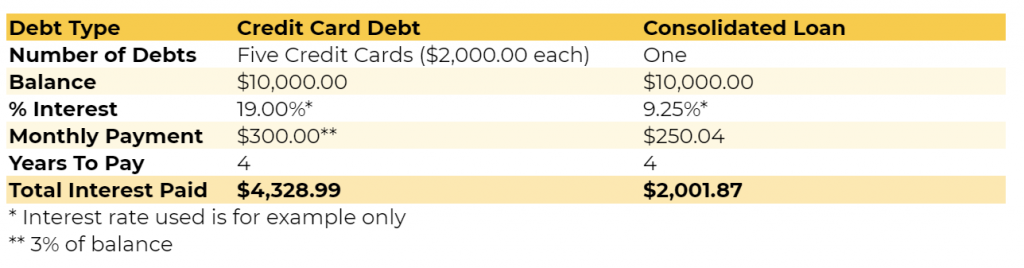
To demonstrate why a consolidation loan may be the ‘right’ choice for you here are two scenarios to think about:

credit card debt vs. consolidated loan

As you can see in the example above with the consolidation option, you save money overall in interest costs + would be paying $50.00 less each month! Mainstreet also offers additional insurance options you can add to loans that provide peace of mind by covering the debt of the loan if you suffer a death, critical illness, or a disability.

Here are a couple of very helpful calculators that can be used to demonstrate how you can benefit:

Mainstreet Credit Union – Loan Calculator (mainstreetcu.ca)
Credit Card Payment Calculator – Canada.ca (fcac-acfc.gc.ca)

Of course our staff can always help by working with you to review your borrowing – whether loans, credit cards, mortgage or more, to ensure you have the best financial plan and lowest rates possible to save you money. Book a meeting with a Mainstreet Financial Advisor to get started today.

Financing and Building Your Dream Home

Written by: Marina Kraft | Financial Advisor | Strathroy Branch

If you have been searching and searching and haven’t yet found your dream home, building one from the ground up might be the right solution for you.

A few things to consider if you are thinking of undertaking a home build:

  • You’ll need to secure a special construction/builder’s mortgage. Note: There can be additional financing costs for this mortgage type.
  • Do you currently own land, or will you have to purchase a property? Vacant land may require separate financing, or if you currently own a home, you may be able to secure a Home Equity Line of Credit (HELOC) to purchase the lot.
  • Be sure to do your research. Ensure you will be able to obtain permission to build from the municipality and/or conservation authority. Also research zoning, environmental, the availability of utilities, high-speed internet, etc. Should something need to be addressed, the cost of these items can be significant and will need to be addressed in the build budget.
  • Ensure you have a home builder/ general contractor you trust. This will ease much of the work around the build and managing the sub-trades. As well by Ontario law, a build contractor is required to provide a warranty (typically through Tarion). Be sure to carefully review what is covered under the policy. There is also the option if you have the background, expertise, and disposable time to manage the build yourself (“self-build”). Note that some financial institutions may charge higher fees for a “self-build”, as it poses more risk, and requires you to obtain an “all risk builder’s” insurance rider on your home insurance policy.

How does a construction mortgage work?

Funding for the build project will be advanced by the financial institution in stages, based on the completion of the build. There are generally two methods used to calculate how much is given in each stage:

  • Progress Draw Mortgage: A home inspector will be sent to the property to review the progress of the build to ensure it is going to plan. The inspector completes a report for the financial lender, and if all the components of the stage are completed, they will advance funds. Should the inspector indicate the project is not progressing on plan, the financial lender may hold back some of the scheduled funds until the construction is back on track. Each time the inspector visits the project, a fee is charged (typically to the borrower). Typical stages are: Foundation (excavation, foundation, backfill & framing); Shell (windows, doors, exterior finishes, and roof); Drywall (includes plumbing, electrical, HVAC, duct system and insulation); Finishing (drywall, painting, finished flooring, electrical fixtures, finished plumbing and carpentry).
  • Percent Completed Draw Mortgage: This method is a little more fluid. The inspector completes a report for the lender and indicates the percent of the project completed and that percentage will reflect how much of the total mortgage is funded to the borrower.

For both types, as part of the Construction Liens Act there is a required 10% holdback amount that is kept aside from each draw and accumulates to the end of the project. Once the build has been completed and you’ve received the official occupancy certificate from the local building inspector, there is a 60-day waiting period before the lender releases the accumulated holdbacks.

Separate to this, it is recommended that you have 10% or more of your home’s build cost set aside for unexpected and extra costs that can arise throughout the project.

Building a new home and acquiring a builder’s mortgage may not be for everyone; however, a well thought out and thorough financial and build plan will help to ensure a smoother path to creating your dream home.

Mainstreet and our advisors are here to help you build your dream home and apply for a builder’s mortgage/financing. Book a meeting online or call your nearest branch location.

Contemplating Taking a Break?

Written by: Doreen Welsh | Commercial and Agricultural Account Manager | Goderich Branch

COVID-19, and the onset of the pandemic, brought fear and panic to many.

Job layoffs, business interruptions, and closures, along with the hesitancy to leave your house for fear of contracting the virus, forced us into unknown territory and left many wondering how to cope in this changing world, and how to continue to meet financial obligations.

At Mainstreet, we are very committed to assisting our members through difficult times, and we continue to work with each member to manage the effects of this pandemic.

Life happens, and we understand there may be times when it is necessary to take a break from a regular financial obligation, such as your mortgage.

Before making the difficult decision to skip your mortgage payment, we recommend that you take a few minutes to discuss with your Mainstreet advisor, the various options that best meet your needs, now, and for the future.

Together with your advisor, you can weigh in on the short, and long term effects of skipping payments, things like:

  • how much more interest will I need to pay
  • what happens to the missed principal portion -when payments resume, depending on the amount, rate, and amortization of the mortgage, it can take 4-5 months to catch up just the interest portion of the payment
  • if I need to add missed principle to the mortgage at maturity, how much time does this add to my mortgage
  • how can I catch up to reduce costs over the long term

If you need help to determine what is right for you, we encourage you to reach out to your Mainstreet advisor to help you make an informed decision.  Book a meeting with an advisor today.